Monday, July 3, 2017

It's a mystery!

After a few hours experimenting with the new bilge fan, I'm presented with somewhat of a mystery. I am no further forward in having an answer as to whether the fan does anything or does nothing. Part of the answer is probably due to the weather which changed (somewhat unhelpfully) from sunny to cloudy.

The chronology went something like this...
  • 1:13 started the ventilation system with the end of the unit including the filter standing on the bottom step in the entrance, with the door open enough to accommodate it. It was 95 in the bedroom area. The tube was extended half way through the galley and I could feel a breeze.
  • 1:25 I took the filter off to see what difference that made. There was an appreciable increase in the amount of air flowing through. It was still 95 in the bedroom.
  • 1:32 still 95F in the bedroom. Taking the thermometer and leaving it in the air from the ventilation tube dropped the thermometer to 91. Then I took the thermometer outside and it rose to 93 and stayed at 93.
I concluded extra induction seemed to make little difference to overall temperatures. This was good and bad news. The good news was I didn't have to scrabble around under the bus installing ventilation. The bad news was I'd not achieved much. Having said that, the next thing was to see what the fan does when blowing air through my exhaust vents.
  • 2:05 With the interior temperature at 97, the fan was connected to an exhaust vent. By 2:12 by my calculation all the air should have been expelled from the bus. I gave it til 2:20 for good measure
  • 2:12 Well, I went outside and when I returned found the duct tape attaching my ventilation duct to the exhaust vent had fallen off so at 2:15 I started again. The internal temperature was still 97F.
  • 2:40 I stopped the experiment. The thermometers hadn't changed any but the bus felt cooler.
One thing I haven't mentioned is that the humidity dropped while my fans were going. Then afterwards the humidity climbed. I believe at one point it was 50% but at the point of writing, the thermometer read 93F and 58% humidity.
  • 3:27 I restarted my bilge extraction fan. The thermometer read 93F and 58% humidity.
  • 3:42 I stopped the fan. The thermometer read 93F and 59% humidity.
The biggest challenge thus far has been the useless nature of duct tape. I know I'm only holding things temporarily in place while I experiment but even so, it could be better!

A few years ago, I lived in a townhouse and never once used the air conditioning. Sure, it got warm in summer but I couldn't afford to blow money on air conditioning. My income was solely what I had from my job and it didn't pay much. Roll on a couple of years and I was stuck in a job that paid even less - so little that I could not afford to pay rent and had to move out of my disagreeable little hovel.

Back in my hovel, I found that a cheap little fan though not as icy cold as an air conditioner made a huge difference as did the fact that it naturally gets cooler at night. For a long time I've maintained that it's better to have moving air than icy cold air. Indeed, standing outside, it seemed cooler than inside the bus but wasn't really. It was due to lower outside humidity and the fact the air was moving.

As I wrote this blog entry, though initially I sweated profusely, when I remembered my $6 battery powered desk fan, I felt cooler having switched it on. My existing extraction fans are CPU fans. They remove a decent amount of air. I did have some 3V fans there before that probably didn't remove quite as much air but which worked. It seems to be a case of diminishing returns. It's something I shall have to think more on. Perhaps the answer lies not in more powerful fans but in more low powered fans just to keep the air moving toward the back of the bus.

Sunday, July 2, 2017

Over a hundred!

Today the temperature inside the bus reached 100. As I sat putting connectors together the sweat was trickling down my back. Needless to say, after a while in the bus I was pretty hot and sweaty. This is exactly the weather I need forced air ventilation. My mind turned the problem over while I worked on today's project.

What I had planned was pretty straightforward. I was going to attach two single cables together in order to have just have two duals going to each battery in my battery box. I also had to extend the two single cables in order to have a dual of sufficient length. That was fairly easy soldering and I slipped some shrink sleeving onto the cables. 
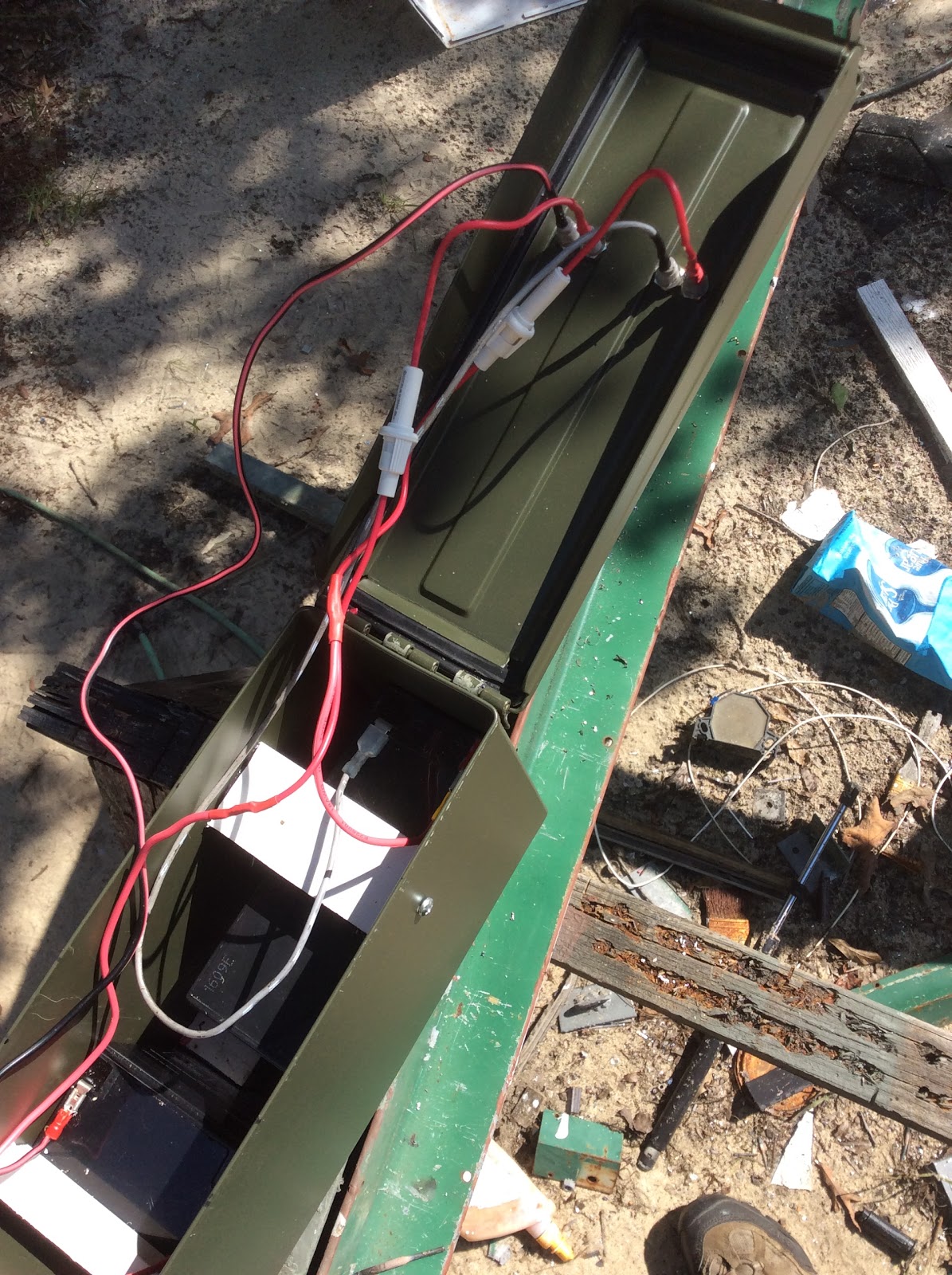
The floor could stand some tidying as could the whole bus. Here you can see my cables in place and if you look carefully at the top of the ammunition box, you can see I've written 10AH on one side. The other side has 5AH. The rear fans which are CPU fans run off a 5AH battery. The induction fan will run off a 10AH battery.

I did more thinking about my ventilation system and decided to try everything out before diving in to make something that I might later decide not to use. That's several times I've spent time and money welding together things that for one reason and another I ended up not using.

I looked at my fan and decided I needed a hose to carry the air. I've already decided not to have an all in one unit but to have a separate inlet manifold, filter unit and fan unit. Looking around, the usual suspects didn't have much so I looked at the marine supply stores. Bingo! I found a hose for my ventilation fan. Without further ado, I jumped in my car and headed off to West Marine. Yes- I'm over a hundred miles inland and there's a ships chandlers not far from me! Weird but this is the USA where odd things abound.

It transpired that the hose is not really that robust. It's certainly not something I can leave permanently attached. It was $15 which isn't that horrible when I have to experiment anyway. Combined with a sandwich box and my Honda lawnmower engine filter, I knocked up a ventilation unit. 
I expect the filter to have to go fairly quickly. I think it's way undersized. I'm leaning more toward the  filters I was looking at the other day. Both the vacuum cleaner and the air cleaner filters have better throughput than the car engine filters. 

The goal is to put the filter end of the unit outside the bus and to pull the hose into the bus. It reaches 15 feet or so. With the door partly closed I should see fairly quickly how well outside air injection lowers the internal temperature. As I've said, I expect the filter to be the bottleneck which is why I expect to have to replace it with mosquito mash fairly quickly.

If the tests are a success then I'll get on with finding the right filter. I like the volume of air that will pass through a shop vac filter but it's hard to design a case to hold it. I feel an air cleaner filter may well be the solution. As far as tubing is concerned, it'll probably have to be plastic drainpipes.  For the moment though, my temporary ventilation system will have to suffice. There are too many critters under the bus for the moment. 

Having a cooler bus will allow me to get on with the next stage which is to go through the stuff inside, getting rid of the unnecessary junk. Junk builds up very quickly!

Saturday, July 1, 2017

143 minutes

Regular blog readers will know that I'm known for being stingy. In fact, the joke is that I'm tighter than a Jewish Scotsman who's trying to save money. Anyway, you all know I dumped smartphones when mine started playing the fool back in October. Yesterday I had to pay my flip phone for the month. That came to $17.23 which I consider a real rip off. Over the last month they reckon I used 143 minutes/texts. As if it's not bad enough having to fork out $15 for 300 minutes (that I barely use), I had to pay an extra $2.23 or 15% extra in junk taxes! I'd be happy to go over to smoke signals.

So, today I soldered plug connectors to my wires for my small battery pack. That worked well. I have more soldering to do but it's all looking a load better. The next thing was to work on the under counter wiring. Well, I was not keen on going under the counter so I took the countertop off. That wasn't too hard. It was only ten screws.
Looking at my wiring I'd given myself somewhat of a problem. I'd used 30A cabling instead of 20A which made working with it rather challenging. I struggled valiantly or at least as valiantly as one can in 95F. After releasing one of my two cables from both ends, I couldn't budge it. There was nothing obvious holding it in place either. Taking an executive decision, I removed the other cable. With both cables cut loose I saw the problem. I'd connected the earths to a bolt that was obscured.

After junking my (probably expensive) 30A cables I pulled out some 20A cable. Then I went to cool down. Sweat was running off my forehead into my eyes and my tee shirt was soaked with sweat. I worked off and on for most of the day on the wiring with pauses in an air conditioned house as the internal temperature soared to 97F.
While I worked, I regretted that I didn't have my ventilation up and running. While I might get underbus odors from running with an intake directly under the bus, that might be my best way forward for the moment. If I put together a box that takes the Shop Vac filter with a PVC end into which my 3 inch fan is fastened then I can just build an all in one unit that should be relatively simple to attach. If the box is open on one face only or is set so that I can attach a 3 or 4 inch inlet hose, I can just install it and wait until I feel like doing extra work.

Eventually, dripping with sweat, my 120V system was completed. Last time I lay on my back under the counter doing it all and I think it took days. Today I just took the countertop up and did the whole thing in a day.
You can see the cramped space. I cannot imagine why I was lazy enough to work under the counter the first time around. I'd also way overdone it with the heavier cables. This time around it was nowhere near the fight I must have had last time.

My ventilation fan shifts a goodly amount of air. As I've already said, it can replace all the air in the bus in just seven minutes. That has to be my task for Monday.

The plan was to complete my extraction fan soldering and to complete putting heat shrink sleeving onto the wiring for my battery pack. I'd already done some soldering. I looked at the clock and something didn't feel right so I quit for the day. Better to stop rather than to plug on and make a hash of something and I'd already cut one cable a bit shorter than I'd like.
There you can see the plugs I soldered this morning and my yet to be deployed bilge fan.

Friday, June 30, 2017

It arrived!

Today I went shopping. I seem to be having Fridays off, these days since the school year has ended and I'm now working the maintenance program. I'm usually working 6:30am til 4pm Monday through Thursday and that's been interesting. Sometimes I've been driving a huge truck with a low geared manual transmission and sometimes hefting boxes. It's all good clean fun.

On my shopping excursion I spent plenty money though I didn't seem to get much for it. There was the usual trip to Harbor Freight followed by a trip to Walmart where I browsed filters, thinking about my new fan. After that it was a quick trip to Lowes (hiss, spit) where I hunted to find something akin to a junction box but it seems the USA isn't advanced enough with electrical parts to have junction boxes. In the end, it works out cheaper just to totally rewire the faulty socket with fresh wire straight to the distribution panel. Wacky!

Looking at filters, I was thinking of going back to my original idea of having the fan connected to a filter unit which is then connected to an air intake. I liked the look of the big circular filters that the shop vac has. I also like very much the flat filters that cars use. I'm quite tempted to use the same filter that my Xterra uses as the engine air filter. That's flat and fairly big. The shop vac filter has throughput as the big advantage though.

Arriving home, my fan had arrived. The first thing I did was to connect it to my battery pack whereupon it blew a powerful blast of air. By my new calculation, the 130 cubic feet per minute fan should replace the entire volume of air in the bus in just 7 minutes. Needless to say the 2.7 amp draw of the fan blew my 2 amp fuse fairly swiftly. Then one of my connectors disintegrated on my battery pack.

Today has been one of those days. Dark, heavy clouds, thunder and lightning and a headache that has lasted all day. I'm so lucky to be living here though. Where I came from originally such weather, headaches and the melancholia induced would last for weeks without respite.

The new plan is to fund a suitably universal filter that can stand a years worth of use then to build some kind of housing for it with a door that permits easy filter changes. A flat filter would give the least challenging set of problems and a rectangular case would be easier to fabricate. If the air were sucked down through the filter and the filter horizontal there would be little to no need to secure it in place as both gravity and suction would work.

As far as an air inlet goes, I still like my sink outlet idea but I believe I may have a better idea with a tube coming straight up with a strainer on top. They sell those! It's just a bigger air inlet.

No photos today. It was just too dark, wet and depressing.

Wednesday, June 28, 2017

In the wake...

In the wake of the failure of my CPU fan based air injector to inject enough air to make a difference, I looked online and found a marine bilge fan that purportedly blows 135 cubic meters of air a minute. It has a very high power usage at 2.5A but if it really does shift that much air then there are two solutions.

The first is to replace both of my existing extraction fans with the new more powerful fans. This might involve relocating the battery pack to the back of the bus and reallocating the cable that runs the length of the bus to connecting the three solar panels in parallel. That should allow for fairly powerful air extraction.

The second is to leave the extraction fans as they are but to add an air injection system using force injected, filtered air powered solely from the front solar panel.

The problems as I see it is with extraction only, the roof vent at the front might drag wet air into the bus and pollens could be sucked in. With air injection, the noise level could be high. There's also a chance of moisture injection.

I definitely have to try to do something about the temperature inside the bus though. Anything higher than outside temperatures is unacceptable. Whatever I do though has to be powered from 35W of solar panels. There will be no additional solar capacity added.

Another option could be just to replace a single extraction fan with a more powerful alternative and see what happens. The aim is to remove hot air and replace it with cooler outside air.

Meanwhile, somebody asked me why I don't do Facebook. The answer is that I just don't find Facebook to be a pleasant and engaging experience. Rather the opposite in fact. I found my naively innocent responses seemed to result in angry and ugly words aimed in my direction. Then I'd find my feed would be swamped with generic reposts from accounts not in my friends list that would never be in my friends list either. Thus, since all Facebook did was raise my blood pressure, I deleted it. I've deleted Facebook several times in the past after other users rudeness and arrogance became too much to bear.

I can't honestly say I miss Facebook. Sure, there were a few people I knew on it but largely they didn't post either. The problem comes from the fact that in order to sell advertising space, Facebook has to have as wide a user base as possible. That means that the lowest common denominator has to be accepted and that includes those that have not yet learned to wear shoes, bathe and to not make messes in the house.
As I didn't want to become an alcoholic, dealing with the cruel things people commented on my Facebook postings, instead of buying ever more booze, I deleted the Facebook app. I've been happily Facebook free for ages.

Sunday, June 25, 2017

Temperature differential

Its cloudy and midday. The temperature outside is 78.8 but inside the bus it's 86. That's a small difference though I'm sure it gets more on hotter days. At least it's not the 140 that I recorded two years ago inside.

I've rethought my ventilation unit. While I could patch what I have by increasing the tubing size or adding a second fan, what I've opted for is a radical redesign. This time I'll use a 130CFM marine bilge blower. That's a bit more powerful than my existing CPU fan. At least it's a dedicated fan!

Thinking more along those lines, because the fan I ordered is 3 inch (I should have gone for 4), I can still use my sink tailpipe as an inlet though I might want instead of using just one which is 1.25 inches in diameter, to use two. The surface area of one tailpipe is 3.927 square inches while the surface area of a 3 inch tube is 9.425 square inches. Having said that, since the whole of the tailpipe is not open, it could be worth using three or even four. That would allow me to spread my ventilation around the cabin and even into the cockpit. Alternatively I could just cut a square hole in the floor and after treating the bare edges, put a square vent with a vent cover.

The new fan which should arrive on the 30th is much more powerful at 2.5A. It might be all my front solar panel can handle. At a maximum 15W or more likely 10W, it would take about three times as long as the fan runs to charge the battery. As I found with my rear extraction fans, the best way of doing that is to use a small battery and thus increase the cycling. When the weather gets colder and the bugs have gone, I'll be able to get underneath the bus to install everything, including extra underbody cabling. I will probably connect the solar panels in order that the power can be better utilized.

As far as filtering is concerned, an increase in filter size is definitely in order. I'd been thinking solely about vehicle engine filters. Now I'm wondering whether Hepa air cleaning filters might be a better route since they're bigger and designed for faster airflow. Having said that, they do allow more garbage through and they're not as resilient. It's a toss up, to be honest. Rather than building a brand new filter holder from scratch, I'm tempted to return to my old idea of using an ammunition box to hold the filter. It wouldn't take much to cut some sheet steel, tack weld it into place and seal with silicone sealant. Nor would it take much to build a little trap to hold it in place. Suction from the fan would pull it more firmly into place. I'm tempted to make it accessible solely by going under the bus and changing it in the winter only. That way I can just have a straightforward ducted vent on the skirt with nothing heavy involved. Even the commonly available vent tubing is light weight.

Many people ask why I don't just put an air conditioning unit on and have done. Sure - I could do that. I don't want to though. I'd rather do it this way so I can avoid adding too many solar panels and or batteries. I do have a 120V plugin and I really don't want to put an AC unit in. They're big and bulky and I'm not too sure how good my structural welding is.

Speaking of welding, I started on my power supply unit today. The plan was to use an ammunition box as the base. As usual I started with complicated ideas first. The intent was to put an XLR socket plus a panel mount fuse for each of two batteries plus a switch. I was going to weld some holders to keep the batteries from slopping about in the box too. As usual though, reality sets in.

The first thing I did was to haul out my welder and weld a holder. Needless to say, the first weld was very strong but in completely the wrong place. My carefully inked line moved all by itself and the bar I'd welded was half an inch out from where it should have been. Disillusioned, I put my welder away and went with another solution.

I'd had plenty leftover plastic planking from doing the bathroom floor. They'd been lying in the yard for two years but that makes little to no difference as they don't decay or get attacked by bugs. A few minutes with my marker (this time I watched my line carefully in order that it didn't getup and move. These pesky lines are awkward like that) and then a few minutes with a hand saw and my pieces of plastic were cut.

Finding panel head screws was challenging but since I organized my screws and bolts better, it was significantly less challenging than before. If only I could say that about my tools! So, the next thing was to drill holes through the case and into my plastic pieces. That actually worked quite well.
The next stage was to connect wires, fuse holders and terminals to the batteries and the ammunition box. That actually went along quite quickly and I remembered my heat shrink sleeving. I'd never used it before but it worked remarkably well. I'm a convert! I'm not sure where I'll find heat shrink sleeving now that Radio Shack has gone under.
The fuse holders and in fact most of my useful electronics came from Radio Shacks going out of business sale. I spent $20 and got probably $50 worth of stuff though at Radio Shacks normal prices they'd probably have been $250 or thereabouts.

I've used banana plug terminals that also accept spade connectors. It's completed as it is but there are always add one that can be included. The main reason I didn't use my XLR connector was I needed to drill a one inch diameter hole and my biggest drill bit is 1/2 inch. My step drill bit committed suicide a while ago and I've not replaced it.

My next task will be to put the correct connectors onto leads from my charge controllers in order to use my new battery compartment. I've chosen an ammunition box because it's sealed with an airtight seal and is non flammable. My batteries are all sealed so they shouldn't leak or anything but a steel box should ensure safety. Any fire should rapidly smother itself. The ideal would be to install these batteries under the bus for safety, which I might do in due course.

The battery box is not currently in use but will be next weekend or even perhaps on Tuesday. Tuesday is not a normal bus day. In fact, it should be a work day but I've had to take the day off to go and visit the IRS. It seems my employer went and lost all their payroll information and thus false claims have been filed and I have to go and prove who I am. So, after that, I'll probably come home and do some bus work.

There are two batteries in the box. One is a 10ah battery that'll run my induction fan. The other is a 5ah battery that normally runs my extraction fans. Currently I've got one of my two 7ah batteries doing the job until I can put the right connectors together to connect the battery box to my charge controller.


Saturday, June 24, 2017

Well, bugger!

Today I gave my ventilation unit a thorough test. I connected it to a 12v battery and put the unit on a box outside then set it going, with a ventilation tube running into the bus.
It seems that I need to pump more outside air into the bus than that is capable of. The beauty of my design is that everything was filtered and it didn't take up a window unlike my previous design. That design worked but definitely could have stood some redesign and improvement. I'd still like an underfloor design and I still want to avoid air conditioning.
I think the problem with my system (built strongly and over a couple of months) is threefold.
  • The Honda lawnmower engine filter just isn't big enough. Even with a CPU fan, it restricts the airflow. 
  • The 1.5 inch tubing used is not big enough (shown).
  • The CPU fan though blowing gallantly cannot override the other two issues.
After putting the newly built system away, I pulled out my old window based unit that I'd built from cheap battery fans and plywood. Although it's funky about which windows it'll fit into, it brought the temperature down from 95F to 91F fairly quickly.
It's not a unit I much care for but it does actually work. It's just two O2 cool fans from Walmart that I bought on sale a year or two back. The batteries had festered (Dollar General brand) but with some fresh Harbor Freight batteries it was up and running.

So, where now? Let's look at the list of options.

  • I don't want to use massive batteries, solar arrays or a generator.
  • I don't want an air conditioner of any variety.
  • I want filtered air blown in from underneath. 
  • I need air flow rather than cooling.
  • I have two solar setups to draw from totaling 35W. 
  • I did mentally design a ventilation system using a separate blower and filter unit.
Sitting here by my window unit I feel far cooler than I was before despite the temperature being only two degrees lower. The humidity has plummeted from 67% to 55% just in a few minutes. Clearly I need to push greater volumes of air through. 


I had been thinking of making filter changes easy by having filter access on the side of the vehicle. That, however, comes with other issues, the main one being the weight of the unit. Moving on from there, it should be possible given the steel just lying around nearby to build a big filter box or to obtain something similar from a scrap merchant. What I need is a 12v turbo fan to power it all.