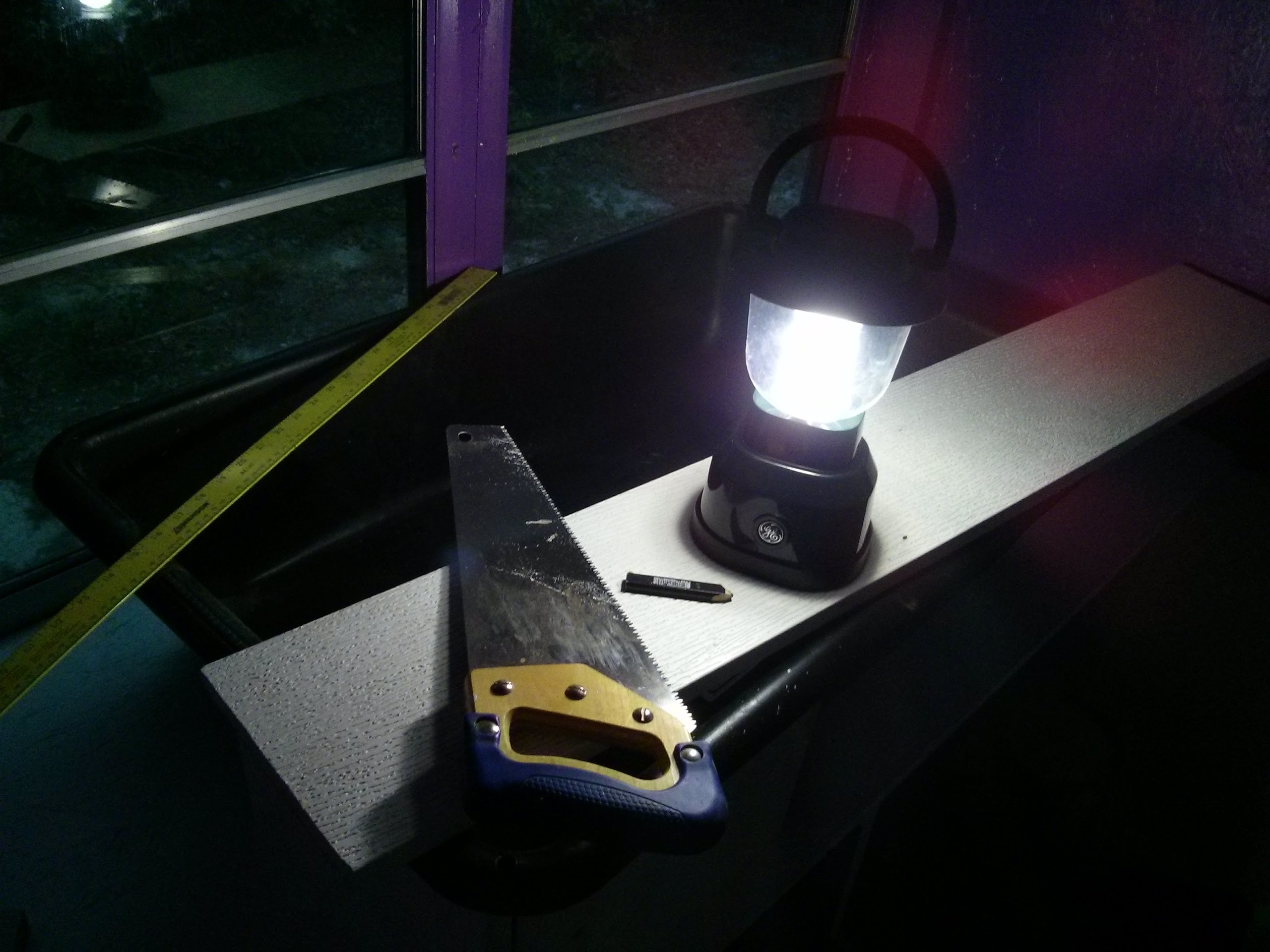
Speaking of welds, I welded some scrap steel together. This is so that m'lady's niece's boyfriend can his destructive streak and try to destroy it. If he can then I'll have to look harder at my existing welds.
Motorhome self build project. Built and designed by one person over the course of about 36 months. The base is a 1994 Carpenter school bus. The end result will be a low energy consumption motorhome.
Showing posts with label peltier. Show all posts
Sunday, December 20, 2015
I got me some sugar!
Yup - after spending a rather unproductive time using soda as a blasting medium with my Harbor Freight air blasting tool, I located a small container of sugar that I poured into the blasting head. The difference was immense. I could bring the paint down to bare metal when I needed and managed to roughen the surface of existing paint.

It is indeed regular cane sugar. The traditional thing to use is sand or preferably silica free sand. Given that sugar is a substance broken down easily by the human body, I'm not too bothered about inhaling minuscule quantities though I hold my breath while I'm blasting. Sand contains silica which causes silicosis - a really nasty and frequently terminal lung ailment. The best thing is sugar is available just about everywhere. A 20lb bag is cheap in Walmart while for sand I'd have to go further and pay more.

Lacking time to paint properly as it was getting close to dusk, I pulled out the first spray can I could locate. Meanwhile, I have been wondering whether I should change the paint scheme. On one hand, I can get grey fairly readily. On the other, I could paint the bus a more interesting color. I'll probably stick with grey on the basis that most of the paint is probably not going to peel. If necessary I can use a steel brush or sandpaper for occasions when the compressor is unavailable.

One of worries is whether my welds are good enough. I'm going to have to find a real welder and ask his opinion. I think my battery compartment is going to be strong enough. Mind, I've just measured it against a nearby car battery. It seems that the door the hillbillies put on is not large enough to allow a full sized battery. Thus, my plan of using gas seems to be much more of a thing. I can build a smaller cage to hold a small gas container. No need for a huge one as far as I can see. I can get away with a smaller battery because it's not going to be used for powering mains equipment. I'm thinking small electronics such as my tablet and my phone etc.
Speaking of welds, I welded some scrap steel together. This is so that m'lady's niece's boyfriend can his destructive streak and try to destroy it. If he can then I'll have to look harder at my existing welds.

Looking at my bus batteries, they were down to 50% so I put them on charge to bring them back up to 100%. The bus has been sitting idle for months. That's not good for the batteries but one day I'll get around to installing my solar panel. That should keep the battery topped up.

The solar panel I have should keep the bus batteries topped up. I suspect a similar sized panel might be sufficient to provide for my daily electrical needs unless, of course, I decide to install a fridge that runs off 12v. As I've mentioned, I'm experimenting with Peltier elements and these form the basis of 12v fridges. Now a single Peltier would use around 60w or 120ah. To make a freezer, 4 Peltier elements would be needed, using 480ah. That's way in excess of what I'll set up to do. I figure 10-15ah is all I'll likely need if I use gas. Indeed, since my microwave is close to being deceased, it's not too much of a stretch to put a gas hob where the microwave used to be. indeed, I suspect that I might have been better off not installing the 120v setup at all but rather, installing 12v and gas. Having said that, I have what I have. It'll all probably work out for the best. The goal was to have all electric and while that is possible, it's not of immediate financial practicality.
Speaking of welds, I welded some scrap steel together. This is so that m'lady's niece's boyfriend can his destructive streak and try to destroy it. If he can then I'll have to look harder at my existing welds.
Sunday, December 13, 2015
Invaders from Mars arrived today.
Or perhaps that's what m'lady and her dogs thought when they ran, screaming, for the hills when they saw me in my welding outfit.

Today my welding was much better. Indeed it looked a lot closer to what a professional would do.


On the whole, I was happier with today's welding. Unlike last week I sprayed my welds with rust killing paint because welds are more prone to rust. I'm not sure how much more welding I should do but as I'd become tired, it was time for a break. After that the sun went and hid itself below the horizon. Talk about inconvenient!
I don't know what that website I was reading yesterday was on about but I find welding easiest at about a 45° angle. I suspect like everything else, most of these websites are set up by self taught welders each of whom uses a different technique that they swear is the one and only correct way of welding.
During today's welding I was getting on so well that I exceeded the welder's duty cycle and it shut down to cool off. I was getting some lovely thick welds. It seems a welding rod is good for about 4 - 5 inches. I even managed to build up to fill a 1/8 inch thick gap where I oopsied in my construction. On the whole, this is pretty confidence building.
I'm reasonably confident that today's welding will hold up to the test of use. My next task will be to remove the old hillbilly cable compartment and door then to install my own. Before I do that, I'll probably cut sides and a base for it that can be attached when its in situ. Those will probably be riveted into place.

Meanwhile, I put more silicone caulk on one of the roof seams while standing on a stepladder. I suspect I might need to add more. There's definitely a minuscule leak there.
While I welded, I connected my Peltier setup to my solar panel. Every now and then I'd go back to it and feel to see whether one side was warm and the other, cold. By the end of the day I'd not noticed any difference. This does not surprise me in the slightest. My luck with electronics is never high. Things that should work or are reported to work rarely do. In fact, it used to be 50/50 whether purchased ready made electronics would actually function. These days the percentage of DOA electronics is lower but they still exist. Electronics always seems such an absurdly hit and miss area.
I was reminded of a website I saw before I tried my Peltier setup. The Useless World of tge Peltier Effect Dehumidifier https://secretscotland.wordpress.com/2013/09/13/the-useless-world-of-the-peltier-effect-dehumidifier/ in which was documented one fellow's miserable experience of Peltier equipment. Drawing only 60 W and claiming only 600 ml collection per day (conventional claimed 300 W and 5 litres per day) the numbers seemed reasonable.
Sad to say, the reality has not been anywhere close.
In fact, having run the new dehum under various ambient temperatures and humidity levels, it barely manages to fill its little 600 ml tank in a week, let alone a day.
I really wasn't expecting anything spectacular from the Peltier unit but was hoping for more than *nothing*. Still, I can experiment. It could be that my 5W solar panel wasn't producing enough to tickle a 60W element - which is the most likely reason.
So, over the next week or two I intend to finish installing my cable compartment. Having done that, I'll be in a position to file to have my bus reregistered as a motorhome.

Today my welding was much better. Indeed it looked a lot closer to what a professional would do.


On the whole, I was happier with today's welding. Unlike last week I sprayed my welds with rust killing paint because welds are more prone to rust. I'm not sure how much more welding I should do but as I'd become tired, it was time for a break. After that the sun went and hid itself below the horizon. Talk about inconvenient!
I don't know what that website I was reading yesterday was on about but I find welding easiest at about a 45° angle. I suspect like everything else, most of these websites are set up by self taught welders each of whom uses a different technique that they swear is the one and only correct way of welding.
During today's welding I was getting on so well that I exceeded the welder's duty cycle and it shut down to cool off. I was getting some lovely thick welds. It seems a welding rod is good for about 4 - 5 inches. I even managed to build up to fill a 1/8 inch thick gap where I oopsied in my construction. On the whole, this is pretty confidence building.
I'm reasonably confident that today's welding will hold up to the test of use. My next task will be to remove the old hillbilly cable compartment and door then to install my own. Before I do that, I'll probably cut sides and a base for it that can be attached when its in situ. Those will probably be riveted into place.

Meanwhile, I put more silicone caulk on one of the roof seams while standing on a stepladder. I suspect I might need to add more. There's definitely a minuscule leak there.
While I welded, I connected my Peltier setup to my solar panel. Every now and then I'd go back to it and feel to see whether one side was warm and the other, cold. By the end of the day I'd not noticed any difference. This does not surprise me in the slightest. My luck with electronics is never high. Things that should work or are reported to work rarely do. In fact, it used to be 50/50 whether purchased ready made electronics would actually function. These days the percentage of DOA electronics is lower but they still exist. Electronics always seems such an absurdly hit and miss area.
I was reminded of a website I saw before I tried my Peltier setup. The Useless World of tge Peltier Effect Dehumidifier https://secretscotland.wordpress.com/2013/09/13/the-useless-world-of-the-peltier-effect-dehumidifier/ in which was documented one fellow's miserable experience of Peltier equipment. Drawing only 60 W and claiming only 600 ml collection per day (conventional claimed 300 W and 5 litres per day) the numbers seemed reasonable.
Sad to say, the reality has not been anywhere close.
In fact, having run the new dehum under various ambient temperatures and humidity levels, it barely manages to fill its little 600 ml tank in a week, let alone a day.
I really wasn't expecting anything spectacular from the Peltier unit but was hoping for more than *nothing*. Still, I can experiment. It could be that my 5W solar panel wasn't producing enough to tickle a 60W element - which is the most likely reason.
So, over the next week or two I intend to finish installing my cable compartment. Having done that, I'll be in a position to file to have my bus reregistered as a motorhome.
Saturday, December 12, 2015
Electronics guru needed!
In the quest toward the perfect power system, yesterday I had somewhat of a brainwave. Looking at batteries, I've heard lots of strange tales from those ridiculous forums about it being instant battery death to use one down to zero. Well, I found a table that looks believable about how long a battery will last if it's discharged totally.
It work out that a standard car battery will die within 3 months to a year if it's regularly discharged to zero. A marine battery will die in 12-36 months. Now that sounds very doable. Indeed, if all I have to do is to spend $80 on batteries every six months or so, I'm not unhappy. I calculated my daily power usage should be somewhere around 80ah
The brainwave I had was based around super capacitors. Rather than having a huge bank of 12v batteries providing sufficient amperage to power a microwave, a capacitor bank containing sufficient power to run a microwave for 8 minutes (long enough to cook just about anything). The capacitors could be charged at a rate that wouldn't exceed the capability of the battery. Because capacitors can hold power at 120v, after charging, the output need only be converted to AC. As my microwave uses 1040 watts, I need only to hold about 9000 watt hours. That's 75ah. Like as not, the microwave would be used for only 3 - 4 minutes at a time but extra capacity is always good.
The super capacitors would act as a surge buffer, allowing the use of fewer batteries. Thius could catch on in the RV world. I guess I'll have to find an electronics guru to make it happen.
Today was pretty much a nothing day. I went out to buy more welding rods because I know that what I have is insufficient to complete what I'm doing. Due to the Christmas traffic, it was dusk before I returned. Thus, nothing was achieved. Having said that, it was too hot earlier to wear my heavy jacket in order to weld. Thus, I got an apron and arm protectors. Now I shall be able to weld in a short sleeve shirt and still be protected. Cool and welding!
The plan tomorrow is to get some welding done then having completed that, to put everything under cover as Monday its going to rain and I have yet to paint my welds. Given sufficient free time I might also connect my Peltier gizmo to my solar panel to see what happens.
It work out that a standard car battery will die within 3 months to a year if it's regularly discharged to zero. A marine battery will die in 12-36 months. Now that sounds very doable. Indeed, if all I have to do is to spend $80 on batteries every six months or so, I'm not unhappy. I calculated my daily power usage should be somewhere around 80ah
The brainwave I had was based around super capacitors. Rather than having a huge bank of 12v batteries providing sufficient amperage to power a microwave, a capacitor bank containing sufficient power to run a microwave for 8 minutes (long enough to cook just about anything). The capacitors could be charged at a rate that wouldn't exceed the capability of the battery. Because capacitors can hold power at 120v, after charging, the output need only be converted to AC. As my microwave uses 1040 watts, I need only to hold about 9000 watt hours. That's 75ah. Like as not, the microwave would be used for only 3 - 4 minutes at a time but extra capacity is always good.
The super capacitors would act as a surge buffer, allowing the use of fewer batteries. Thius could catch on in the RV world. I guess I'll have to find an electronics guru to make it happen.
Today was pretty much a nothing day. I went out to buy more welding rods because I know that what I have is insufficient to complete what I'm doing. Due to the Christmas traffic, it was dusk before I returned. Thus, nothing was achieved. Having said that, it was too hot earlier to wear my heavy jacket in order to weld. Thus, I got an apron and arm protectors. Now I shall be able to weld in a short sleeve shirt and still be protected. Cool and welding!
The plan tomorrow is to get some welding done then having completed that, to put everything under cover as Monday its going to rain and I have yet to paint my welds. Given sufficient free time I might also connect my Peltier gizmo to my solar panel to see what happens.
Monday, December 7, 2015
Bloody Hell!
They actually arrived! The two heatsinks I ordered for my Peltier cooler arrived today! I had serious doubts as to whether they would actually arrive, having ordered everything on November 8th and everything else having arrived very quickly.

Unpackaged, this is everything. Two heatsinks, the Peltier element and the heatsink glue.

It was pretty inexpensive - under $10 for the lot. Anyway, I glued it together and when the glue dries (which might take a few days), I'll be able to test it all.

The theory is that putting power through the Peltier element will transfer heat from one side to the other. The problem is, this is electronics and I generally find electronic gizmos have a very high rate of being junk. It's not worth spending more unless it actually works.
So, I'll wait for it all to cure then perhaps hook it up to a solar panel, mount it into a box - perhaps a plastic sandwich box and put a thermometer inside. Then after a while, check external and internal temperatures. If it works, fantastic. If not - its expected.
Meanwhile I looked more into lithium batteries for my bus. I found that only the most expensive were rated for 100A continual output. That's a major problem that makes a generator more attractive. There are other options though.
I looked at supercaps because if a supercap can hold 10ah then be recharged slowly from a traditional lead acid batterry I have a potential solution. The capacitors could release 8ah at 100a quickly then recharge slowly from a deep cycle lead acid battery.
I also looked into building my own lithium ion or nickel metal hydride batteries. Lithium ion cells seem to be 3.7v only. Looking at the costs, both lithium and NiMH seem excessively expensive.
The supercap solution looks the most economically promising but again, it's electronics and they so rarely seem to perform as advertised. I would use a supercap engine starting battery if I could find out their full specifications.
One of the problems if not the biggest problem is that nobody ever seems to publish full usage specifications on anything. It's like trying to sell shoes without mentioning important things like sizes!

Unpackaged, this is everything. Two heatsinks, the Peltier element and the heatsink glue.

It was pretty inexpensive - under $10 for the lot. Anyway, I glued it together and when the glue dries (which might take a few days), I'll be able to test it all.

The theory is that putting power through the Peltier element will transfer heat from one side to the other. The problem is, this is electronics and I generally find electronic gizmos have a very high rate of being junk. It's not worth spending more unless it actually works.
So, I'll wait for it all to cure then perhaps hook it up to a solar panel, mount it into a box - perhaps a plastic sandwich box and put a thermometer inside. Then after a while, check external and internal temperatures. If it works, fantastic. If not - its expected.
Meanwhile I looked more into lithium batteries for my bus. I found that only the most expensive were rated for 100A continual output. That's a major problem that makes a generator more attractive. There are other options though.
I looked at supercaps because if a supercap can hold 10ah then be recharged slowly from a traditional lead acid batterry I have a potential solution. The capacitors could release 8ah at 100a quickly then recharge slowly from a deep cycle lead acid battery.
I also looked into building my own lithium ion or nickel metal hydride batteries. Lithium ion cells seem to be 3.7v only. Looking at the costs, both lithium and NiMH seem excessively expensive.
The supercap solution looks the most economically promising but again, it's electronics and they so rarely seem to perform as advertised. I would use a supercap engine starting battery if I could find out their full specifications.
One of the problems if not the biggest problem is that nobody ever seems to publish full usage specifications on anything. It's like trying to sell shoes without mentioning important things like sizes!
Friday, November 27, 2015
I braved the Black Friday hoard!
Well, not really. I didn't leave the house until 4pm. By the time I arrived at Lowe's (hiss, spit), the car parks were pretty clear and the roads about as busy or quiet as normal. It was pretty mundane in actual fact.

In Lowe's I found the Nema TT 30R that I was looking for. I looked for an adaptor to turn it into a standard household socket but they didn't have one. I would have left it at that but I spied a stand with 60W equivalent LED bulbs for 99 cents each. As bulbs are dying in m'lady's bathroom, I added four and then a flashing LED necklace to spice things up a bit at work over Christmas. I got out for $16.
Next stop was Walmart where I got the Nema 30TTR to Nema 5-15 adaptor and a can on black spray paint they had for 96 cents. I got out of Walmart for about $8.
Returning home, the mail still has not brought my cooling vanes for my Peltier cooler. This looks a bit suspicious! I ordered it on November 8th and the seller provided a tracking number that doesn't state the vanes actually arrived at the carrier. I'm suspecting they're hoping I won't notice they haven't supplied the product.
Tomorrow I hope to complete the wiring for my RV power socket. The adaptor I bought says "don't use for more than 15A" yet looks to be solid brass connectors. I'm putting 20A through it and will just watch to see what happens. I suspect they labelled it conservatively. Worst case scenario, it melts and catches fire. Not a big deal, where its located.
Maybe Sunday I can do some welding!
As far as the heatsink is concerned, I suspect I'll have to buy another elsewhere and try to get a refund off eBay!

In Lowe's I found the Nema TT 30R that I was looking for. I looked for an adaptor to turn it into a standard household socket but they didn't have one. I would have left it at that but I spied a stand with 60W equivalent LED bulbs for 99 cents each. As bulbs are dying in m'lady's bathroom, I added four and then a flashing LED necklace to spice things up a bit at work over Christmas. I got out for $16.
Next stop was Walmart where I got the Nema 30TTR to Nema 5-15 adaptor and a can on black spray paint they had for 96 cents. I got out of Walmart for about $8.
Returning home, the mail still has not brought my cooling vanes for my Peltier cooler. This looks a bit suspicious! I ordered it on November 8th and the seller provided a tracking number that doesn't state the vanes actually arrived at the carrier. I'm suspecting they're hoping I won't notice they haven't supplied the product.
Tomorrow I hope to complete the wiring for my RV power socket. The adaptor I bought says "don't use for more than 15A" yet looks to be solid brass connectors. I'm putting 20A through it and will just watch to see what happens. I suspect they labelled it conservatively. Worst case scenario, it melts and catches fire. Not a big deal, where its located.
Maybe Sunday I can do some welding!
As far as the heatsink is concerned, I suspect I'll have to buy another elsewhere and try to get a refund off eBay!
Wednesday, November 25, 2015
Frustrations
Today started with my laying conduit on the ground from the outside breaker box to where I was going to have my plugin. Then I was going to erect a stake for the socket. The plan was to have the electrics completely done today but as with plans, little was actually accomplished.
The blower swiftly removed fallen leaves and the conduit was layed over the ground. The next stage will be to insert the cable and bury the conduit. I can certainly do better than the Dish Network people that didn't bother burying their cables. An ants nest was revealed and the scurrying ants blown away too.
When it came to cutting a point on the metal stake intended for use with the outside socket, I hit my first big problem of the day. My angle grinder stopped working. After some tinkering, I gave up on it as a lost cause and zoomed off to buy a new one. They're cheap enough at Harbor Freight for $15.

After returning home with my new angle grinder, I proudly plugged it in and it didn't work. Nothing I did could make it work. Putting it away and cursing Harbor Freight, I pulled out a hacksaw and completed the task. Then I drove the stake into the ground.
By then, the light was beginning to fail but I took another look at the angle grinder and found how to dismantle it properly. It seems one of the carbon brushes on the motor had broken. Looking around as I recall there had been spares, I found some that didn't fit.

Clearly either I found spare brushes for another device or Harbor Freight put the wrong brushes in the box. This is rather disappointing and frustrating!
As tomorrow is a party day, nothing will be done. Friday being shop til you drop day, should be good. Everybody will be out on the roads hunting non existent bargains. A good time not to go to Harbor Freight!
Even without an angle grinder, I can complete my wiring in order to run my welder. I fully intend to be welding by Sunday night!
In other news, the Peltier cooler arrived. The glue that fixes it to cooling vanes arrived a few days ago as did the solar panel to power it. I'm still waiting for the cooling vanes.
I've ordered a long permanent magnet to use with a home made coil for my door opening device. Failing that I did see a likely looking solenoid but I'd rather try building something myself first rather than going to a last resort of buying somebody else's junk.

This bus project is taking longer than anticipated. Were I starting again, I would definitely take a different route. Meanwhile I'll have another hunt for the right carbon brushes. Harbor Freight surely can't have been dumb enough to supply the wrong brushes?
The blower swiftly removed fallen leaves and the conduit was layed over the ground. The next stage will be to insert the cable and bury the conduit. I can certainly do better than the Dish Network people that didn't bother burying their cables. An ants nest was revealed and the scurrying ants blown away too.
When it came to cutting a point on the metal stake intended for use with the outside socket, I hit my first big problem of the day. My angle grinder stopped working. After some tinkering, I gave up on it as a lost cause and zoomed off to buy a new one. They're cheap enough at Harbor Freight for $15.

After returning home with my new angle grinder, I proudly plugged it in and it didn't work. Nothing I did could make it work. Putting it away and cursing Harbor Freight, I pulled out a hacksaw and completed the task. Then I drove the stake into the ground.
By then, the light was beginning to fail but I took another look at the angle grinder and found how to dismantle it properly. It seems one of the carbon brushes on the motor had broken. Looking around as I recall there had been spares, I found some that didn't fit.

Clearly either I found spare brushes for another device or Harbor Freight put the wrong brushes in the box. This is rather disappointing and frustrating!
As tomorrow is a party day, nothing will be done. Friday being shop til you drop day, should be good. Everybody will be out on the roads hunting non existent bargains. A good time not to go to Harbor Freight!
Even without an angle grinder, I can complete my wiring in order to run my welder. I fully intend to be welding by Sunday night!
In other news, the Peltier cooler arrived. The glue that fixes it to cooling vanes arrived a few days ago as did the solar panel to power it. I'm still waiting for the cooling vanes.
I've ordered a long permanent magnet to use with a home made coil for my door opening device. Failing that I did see a likely looking solenoid but I'd rather try building something myself first rather than going to a last resort of buying somebody else's junk.

This bus project is taking longer than anticipated. Were I starting again, I would definitely take a different route. Meanwhile I'll have another hunt for the right carbon brushes. Harbor Freight surely can't have been dumb enough to supply the wrong brushes?
Sunday, November 8, 2015
Things that don't work.
Sitting in the bus today, I reflected on things that haven't worked out. Not because of the waste of time and money but because things that haven't worked out have been minimal.
1. My cheap 10-24 bolts that broke under very light pressure.
2. My plan for barrels as water tanks. They're just not available!
3. My multimeter. I bought a multimeter in around 2006 and tried it today. It's totally dead. I tried changing the battery and the internal fuse but it is dead, refusing to move the needle even after twiddling all the adjustments. Yet another gizmo designed not to last very long and another reason not to buy expensive gizmos.

4. Rustoleum paint. This doesn't stick to anything.
5. Silicone sealant. This works well but doesn't stick to PVC. By the time I realised that, I'd already laid my PVC floors. Had I known this before, I'd have used latex sealant instead as that does stick to PVC. That would have meant I would not have needed a shower base. As for the roof, the silicone sealant works but doesn't lie flat. That could be a problem if a tree branch rubbed the raised seal off.
6. Latex paint. This looks good and adheres well. It's just not that rugged.
7. Interior. Were I doing this again, I'd probably do it very differently. I did it the way I have because I was aiming at an all electric installation. I think I'd put less woodwork inside and I'd put a pot bellied stove to compensate in colder weather. I've designed my installation as more of a home for extended periods. I'd probably have been better keeping it more like a weekend camper.
8. It looks like some of my NiCad batteries haven't survived. I tried charging them today.

9. My microwave. Sure it didn't cost much but it should have lasted longer than a mere 2 years. I used it daily from November of 2011 to April of 2015. By mid 2013 the paint was bubbling and peeling. I wouldn't use that microwave now. It's just in too poor condition.

10. Electromagnets - I'd just make my own rather than fiddling about waiting for them to come from China.
As far as I've gone, I'm happy. I need to thin out my stuff - I have too many clothes so I need to get shot of stuff that no longer fits. I might need to thin down on books to - perhaps go for ebooks instead? I've also got a pile of broken mobile phones, old chargers and general electronic wiring garbage - the kind you build up on all the time. I probably need to cut down in crockery too. I have a set of cheap mainstays China that cost me a princely $10.
Since my microwave has clearly died, I'm wondering whether I should go for something like a small gas burner and put an extraction fan in. That would increase water usage as I'd have to do more washing of saucepans but would decrease the need for electricity. That would put me squarely into boondocking territory. Having viewed the prices though, a replacement microwave seems better as well as safer.
Going forward the plan is - given a dry weekend - to redo all the bolts in my underbody compartment. This weekend was a loss because of the rain. There are a lot of dry weekend tasks to be completed, if ever there is another dry weekend. There seems to be somewhat of a plot against me these days as every weekend is wet. I blame the French! Only the French can be underhanded enough to inflict me with wet weekends.
Sealing or rather resealing the roof seams and repainting will all have to be done in due course. I'd love to have done more over the summer but what with heat exhaustion, it was rather hard. It'd be nice to be able to work under cover but building even the cheapest cover over my bus would be prohibitively expensive.
This weekend, nothing much was achieved bar a redesign of the plumbing necessitated by availability of supplies. With luck, next weekend will be better.
I'll have to do something about onboard humidity. 78% is high. Maybe I should get a Peltier dehumidifier and try to run it from a solar panel? If that works, it bodes well for a Peltier fridge.
1. My cheap 10-24 bolts that broke under very light pressure.
2. My plan for barrels as water tanks. They're just not available!
3. My multimeter. I bought a multimeter in around 2006 and tried it today. It's totally dead. I tried changing the battery and the internal fuse but it is dead, refusing to move the needle even after twiddling all the adjustments. Yet another gizmo designed not to last very long and another reason not to buy expensive gizmos.

4. Rustoleum paint. This doesn't stick to anything.
5. Silicone sealant. This works well but doesn't stick to PVC. By the time I realised that, I'd already laid my PVC floors. Had I known this before, I'd have used latex sealant instead as that does stick to PVC. That would have meant I would not have needed a shower base. As for the roof, the silicone sealant works but doesn't lie flat. That could be a problem if a tree branch rubbed the raised seal off.
6. Latex paint. This looks good and adheres well. It's just not that rugged.
7. Interior. Were I doing this again, I'd probably do it very differently. I did it the way I have because I was aiming at an all electric installation. I think I'd put less woodwork inside and I'd put a pot bellied stove to compensate in colder weather. I've designed my installation as more of a home for extended periods. I'd probably have been better keeping it more like a weekend camper.
8. It looks like some of my NiCad batteries haven't survived. I tried charging them today.

9. My microwave. Sure it didn't cost much but it should have lasted longer than a mere 2 years. I used it daily from November of 2011 to April of 2015. By mid 2013 the paint was bubbling and peeling. I wouldn't use that microwave now. It's just in too poor condition.

10. Electromagnets - I'd just make my own rather than fiddling about waiting for them to come from China.
As far as I've gone, I'm happy. I need to thin out my stuff - I have too many clothes so I need to get shot of stuff that no longer fits. I might need to thin down on books to - perhaps go for ebooks instead? I've also got a pile of broken mobile phones, old chargers and general electronic wiring garbage - the kind you build up on all the time. I probably need to cut down in crockery too. I have a set of cheap mainstays China that cost me a princely $10.
Since my microwave has clearly died, I'm wondering whether I should go for something like a small gas burner and put an extraction fan in. That would increase water usage as I'd have to do more washing of saucepans but would decrease the need for electricity. That would put me squarely into boondocking territory. Having viewed the prices though, a replacement microwave seems better as well as safer.
Going forward the plan is - given a dry weekend - to redo all the bolts in my underbody compartment. This weekend was a loss because of the rain. There are a lot of dry weekend tasks to be completed, if ever there is another dry weekend. There seems to be somewhat of a plot against me these days as every weekend is wet. I blame the French! Only the French can be underhanded enough to inflict me with wet weekends.
Sealing or rather resealing the roof seams and repainting will all have to be done in due course. I'd love to have done more over the summer but what with heat exhaustion, it was rather hard. It'd be nice to be able to work under cover but building even the cheapest cover over my bus would be prohibitively expensive.
This weekend, nothing much was achieved bar a redesign of the plumbing necessitated by availability of supplies. With luck, next weekend will be better.
I'll have to do something about onboard humidity. 78% is high. Maybe I should get a Peltier dehumidifier and try to run it from a solar panel? If that works, it bodes well for a Peltier fridge.
Thursday, August 27, 2015
Behold - the shower base!
Certainly it is a 24x46 concrete mixing tub from the farm supply store but it's new purpose is as my $18 shower base.

It's small enough that I could wedge it against the wall and have a ton of space. That might lead to mold however so that's not what's going to happen. It is going to go roughly where shown, held in place by a mount made from PVC planking.

After installing the bathroom floor, I had enough PVC plank left over to make two of the four edges from the plank. Sadly, I'll have to pony up for more but it'll be worth it! The corners will need special care but this is what the corner looks like without special attention. Eventually the corners will be squared to perfection.

Meanwhile, in the hunt for a 12v fridge, it transpired that the 12v heater/cooler fridges are built out of standard coolers with a single Peltier element. The Peltier element is very interesting as it transfers heat from one side to the other when power is out across it. The maximum cooling is 20C or 35F below ambient. That, however is a great playground for experimentation with water cooling systems etc.
Coolers are pretty cheap - I picked one up for $15 new a week or two back. Peltier elements are about $5 on eBay. CPU heatsinks and CPU fans are also pretty cheap. With a little care, a 12v fridge can be built for under $30.
Peltier coolers don't keep things very cold but they should be fine for prolonging the lives of fruit and bread. There was an article I read about one fellow who built an air conditioner using a Peltier element. Apparently it worked well enough. Again, given a water jacket cooler, lower temperatures might be achievable.
Given the horrible efficiency of solar panels I'm giving thought to building a vertical wind turbine. I'm nowhere near ready for it yet but I know exactly how to build it.

It's small enough that I could wedge it against the wall and have a ton of space. That might lead to mold however so that's not what's going to happen. It is going to go roughly where shown, held in place by a mount made from PVC planking.

After installing the bathroom floor, I had enough PVC plank left over to make two of the four edges from the plank. Sadly, I'll have to pony up for more but it'll be worth it! The corners will need special care but this is what the corner looks like without special attention. Eventually the corners will be squared to perfection.

Meanwhile, in the hunt for a 12v fridge, it transpired that the 12v heater/cooler fridges are built out of standard coolers with a single Peltier element. The Peltier element is very interesting as it transfers heat from one side to the other when power is out across it. The maximum cooling is 20C or 35F below ambient. That, however is a great playground for experimentation with water cooling systems etc.
Coolers are pretty cheap - I picked one up for $15 new a week or two back. Peltier elements are about $5 on eBay. CPU heatsinks and CPU fans are also pretty cheap. With a little care, a 12v fridge can be built for under $30.
Peltier coolers don't keep things very cold but they should be fine for prolonging the lives of fruit and bread. There was an article I read about one fellow who built an air conditioner using a Peltier element. Apparently it worked well enough. Again, given a water jacket cooler, lower temperatures might be achievable.
Given the horrible efficiency of solar panels I'm giving thought to building a vertical wind turbine. I'm nowhere near ready for it yet but I know exactly how to build it.
Subscribe to:
Posts (Atom)